
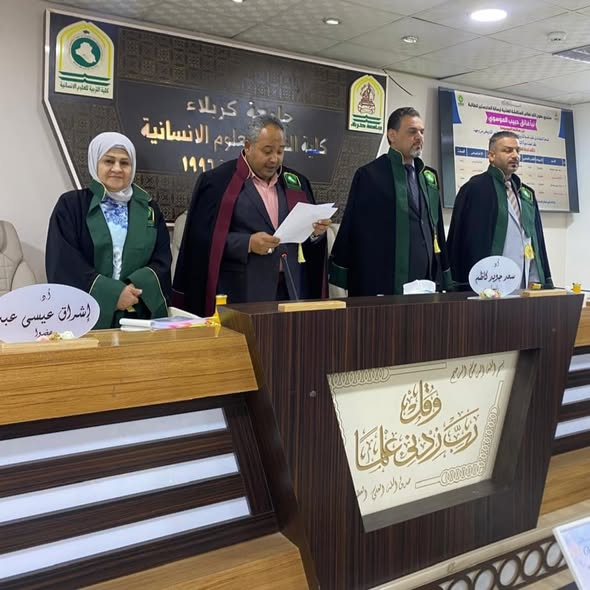
Head of the History Department at Diyala University Member of the Master’s Thesis Discussion Committee at the Faculty of Education for Humanities at Karbala University
Within the framework of scientific and academic cooperation between Iraqi universities, Assistant Professor Dr. Ishraq Issa Abdul, Head of the History Department at the Faculty of Basic Education at Diyala University, participated as a member of the committee discussing the master’s thesis of student Nabaa Faeq Habib at the Faculty of Education for Humanities at Karbala University.
The discussion took place on Tuesday, November 4, 2025, in the Knowledge Hall of the Faculty of Education for Humanities, on her thesis entitled “Learning Styles Among History Students and Their Relationship to Historical Text Comprehension Skills from the Perspective of Faculty Members at Middle Euphrates Universities.” The thesis addressed an important scientific topic in the field of history teaching methods and contributed to enriching the research aspect by raising modern issues and offering precise methodological approaches.
Through her membership in the committee, Dr. Ishraq presented a series of thoughtful scientific observations that enriched the discussion and contributed to strengthening the academic aspect of the thesis, reflecting the distinguished scientific level of the faculty members of the College of Basic Education at the University of Diyala and their active role in supporting the academic movement in Iraqi universities.
The Dean of the Faculty of Basic Education, Assistant Professor Dr. Ayman Abdul Aoun, praised these scientific contributions, emphasizing the importance of academic openness and the exchange of experiences between colleges and universities. He expressed his pride in the scientific competencies of the faculty, noting that these contributions reflect the prestigious scientific status of our faculty among its counterparts nationwide.
The study is in line with the fourth of the seventeen Sustainable Development Goals, which is “Quality Education,” which emphasizes the importance of providing opportunities for distinguished higher education, supporting scientific research, and enhancing the quality of education in line with the requirements of development and community progress.


You may also like

The identity of thought and the memory

Happy New Year
