
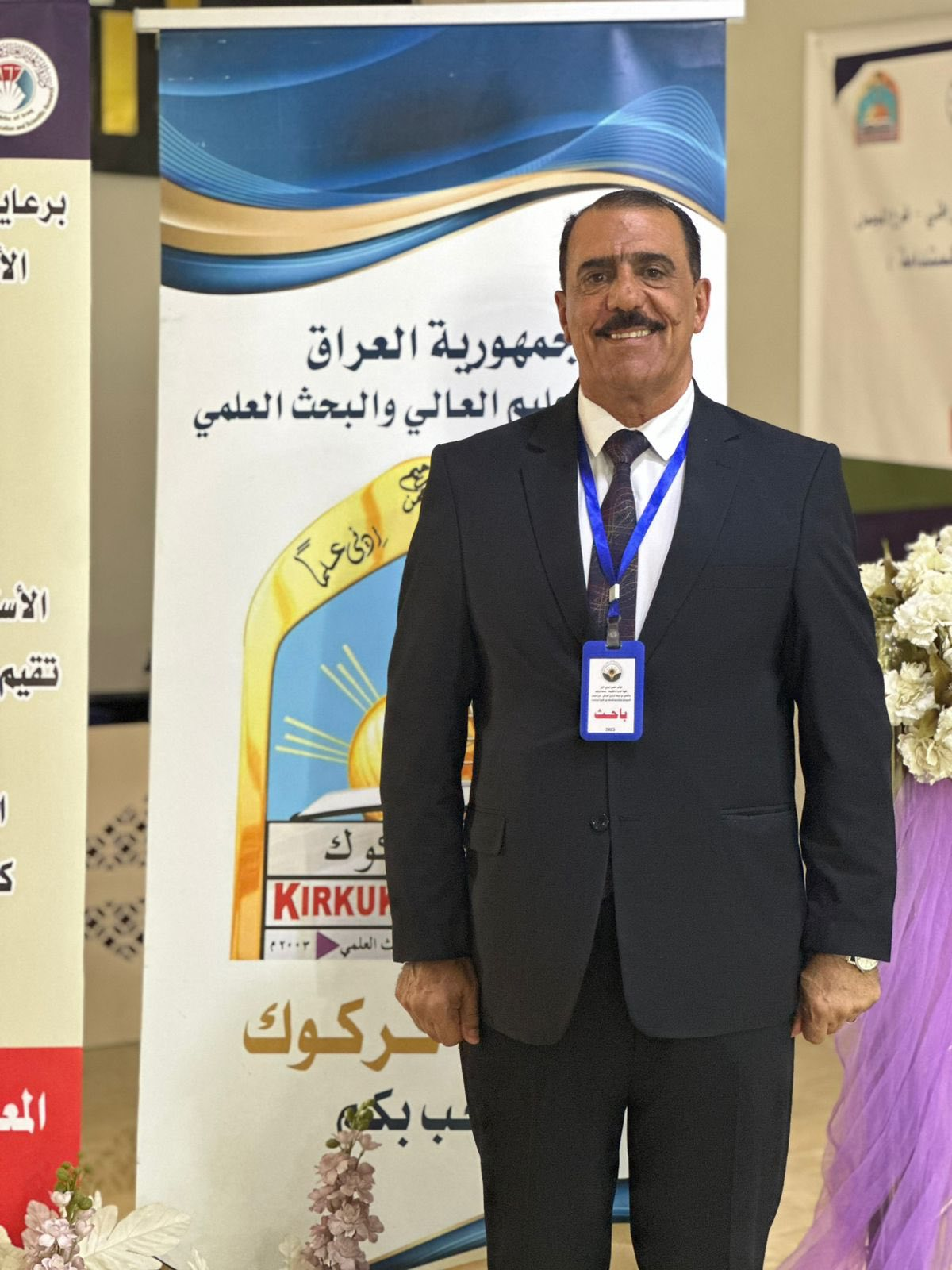
Dr. Jaafar Participates in a Scientific Conference
A critical reading of digital transformation policies… An academic contribution representing Diyala at an international scientific forum on informatics at the University of Kirkuk
In the context of academic openness and active scientific participation in specialized research forums, Professor Dr. Jaafar Hassan Jassim Al-Taie, lecturer in the Department of Computers at the Faculty of Basic Education at the University of Diyala, participated in the proceedings of the first international scientific conference of the Faculty of Management and Economics at the University of Kirkuk, which was held in cooperation with the Central Bank of Iraq – Mosul Branch, under the slogan: “Informatics, Digitization and their Impact on Sustainable Development.”
During the conference sessions, Prof. Dr. Al-Taie presented a scientific research paper entitled:
“Artificial Intelligence and Sustainable Development in Iraq: Analysis of Policies, Obstacles and Digital Transformations,”
in which he addressed the reality of the use of artificial intelligence in Iraq and its relevance to the achievement of sustainable development goals, focusing on the structural, legislative, and economic challenges that hinder digital transformation, with an analytical review of national policies in this field and their compliance with international standards for sustainable development and digital governance.
The research generated extensive scientific interaction and discussion among participants, as it objectively addressed an issue that represents a strategic challenge for both government and private institutions and sectors.
In this context, the Dean of the College, Assistant Professor Dr. Ayman Abdul Aoun, praised the qualitative participation of Professor Dr. Jaafar Hassan Jassim Al-Taie, appreciating his research efforts and his honorable scientific representation of the College in this important international forum, stressing that such participation reflects the College’s orientation towards promoting scientific research aimed at addressing development issues, especially in light of rapid technological changes.
At the end of his paper, the researcher emphasized that digital transformation and the use of artificial intelligence are the cornerstones of achieving sustainable economic and social development, provided that the technical and legislative obstacles that still hinder this path in Iraq are overcome.
This scientific contribution is in line with the 17 Sustainable Development Goals adopted by the United Nations, in particular: Goal 9: “Industry, innovation and infrastructure”; Goal 11: “Make cities and human settlements inclusive, safe, resilient and sustainable”; and Goal 17: “Partnerships for the goals.”


You may also like

The identity of thought and the memory

Happy New Year
